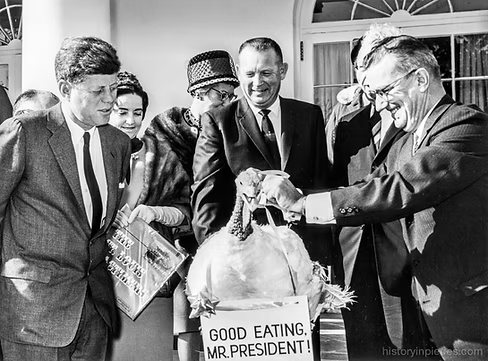
This year marks the 62nd anniversary of President John F. Kennedy’s assassination in Dallas, on November 22, 1963. The majority of Americans who are living now only know about that day from reading about it in history books. Many, if not most, of the people who lived through it are long gone. But even after more than a half-century, this tragic event in particular, and the Kennedy presidency in general, still has a hold on our public consciousness.
When a young person’s life is cut short, especially by violence, we all feel the loss. But we also feel cheated at the potential left unfulfilled, the things left undone. Fortunately for us, shortly before Kennedy left Washington for his ill-fated trip to Dallas, he made sure to take care of some business that all presidents must attend to at this time of year: he wrote his Thanksgiving Proclamation.
We all learned in school about the First Thanksgiving – the great feast the Pilgrims shared with their Indian neighbors who had helped them survive the hardships of a New England winter and taught them how to raise crops in their new home. But while that Thanksgiving in 1621 got the ball rolling, it didn’t immediately give rise to the national holiday as we know it.
After the Pilgrims’ celebration, festivals of thanksgiving were sporadically observed throughout the colonies on a local level for more than 150 years, but there was no formal, annual holiday designated as “Thanksgiving.”
In 1789, with the Revolutionary War over and the new nation established, George Washington added another “first” to his many trailblazing accomplishments when he issued the first presidential Thanksgiving Proclamation. Foremost on Washington’s list of things for which to be grateful was safe passage through the revolution that gave birth to the nation, and praise to God “for the peaceable and rational manner” in which the new nation established the Constitution.
But even that wasn’t really the beginning of Thanksgiving. Washington issued another proclamation in 1795, but his two immediate successors – Adams and Jefferson – did not follow suit. James Madison issued two, in 1814 and 1815. After that, the idea of a national day of thanksgiving lay dormant for almost 50 years.
As the tradition of national days of thanksgiving faded, it fell to the governors, as they saw fit, to issue thanksgiving proclamations for their states. But that changed at the height of the Civil War, when President Lincoln got a visit from his Secretary of State, William Henry Seward. The year was 1863, and it was by almost any measure, the darkest moment in our history. But despite the gloom that had befallen the nation, Seward felt that America had much for which to be grateful. He urged Lincoln to declare a national day of thanksgiving.
Lincoln liked the idea. He issued a proclamation setting aside the last Thursday of November, 1863, as a “day of thanksgiving and praise to our beneficent Father who dwelleth in the heavens.”
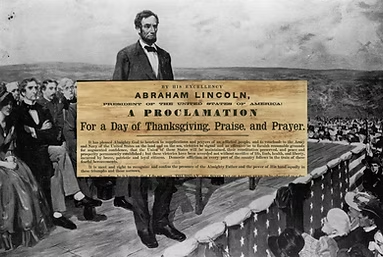
He followed his own tradition the next year, once again appointing the last Thursday of November as “a day of thanksgiving and praise to Almighty God” who has “been pleased to animate and inspire our minds and hearts with fortitude, courage, and resolution sufficient for the great trial of civil war into which we have been brought by our adherence as a nation to the cause of freedom and humanity, and to afford to us reasonable hopes of an ultimate and happy deliverance from all our dangers and afflictions.”
The nation was, indeed, ultimately delivered from the “dangers and afflictions,” but Lincoln wasn’t. He was assassinated in April 1865, just six months after his last Thanksgiving Proclamation. The idea of Thanksgiving could easily have ended right then, but Lincoln’s successor – Andrew Johnson – kept the tradition alive. And because he did, from that time forward – from 1863 to 2025 – there is an unbroken chain of presidential Thanksgiving Proclamations.
That’s why President Kennedy made sure to issue his Thanksgiving Proclamation in early November, about two weeks before his trip to Dallas.
Kennedy began his proclamation by recognizing the Pilgrims’ contribution to the holiday. “Over three centuries ago, our forefathers in Virginia and in Massachusetts, far from home in a lonely wilderness, set aside a time of thanksgiving.”
He then acknowledged the history of presidential proclamations, recalling that Washington’s first proclamation called upon the people of the new republic to beseech God to “‘pardon our national and other transgressions…to promote the knowledge and practice of true religion and virtue…and generally to grant unto all mankind such a degree of temporal prosperity as He alone knows to be best.’”
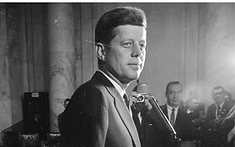
Kennedy then invoked Lincoln, who, “in the midst of America’s tragic civil war…proclaimed the last Thursday of November 1863 as a day to renew our gratitude for America’s ‘fruitful fields,’ for our ‘national strength and vigor,’ and for all our ‘singular deliverances and blessings.’”
Acknowledging that much time had passed since the Pilgrims, and since Washington’s and Lincoln’s proclamations, Kennedy took note that “today we are a nation of nearly two hundred million souls, stretching from coast to coast, on into the Pacific and north toward the Arctic…” Here he was referring to Hawaii and Alaska, which had, only a few years before, become our 49th and 50th states.
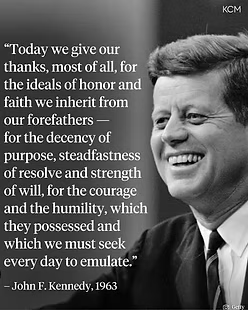
“Yet, as our power has grown, so has our peril,” he wrote. “Today we give our thanks, most of all, for the ideals of honor and faith we inherit from our forefathers – for the decency of purpose, steadfastness of resolve and strength of will, for the courage and the humility, which they possessed and which we must seek every day to emulate.”
He ended by saying that on Thanksgiving Day, “let us gather in sanctuaries dedicated to worship and in homes blessed by family affection to express our gratitude for the glorious gifts of God; and let us earnestly and humbly pray that He will continue to
guide and sustain us in the great unfinished tasks of achieving peace, justice, and understanding among all men and nations and of ending misery and suffering wherever they exist.”
Kennedy, of course, did not live to see Thanksgiving 1963. And so, his final Thanksgiving Proclamation – coming 100 years after Lincoln’s first – ended up being basically his last message to the American people.
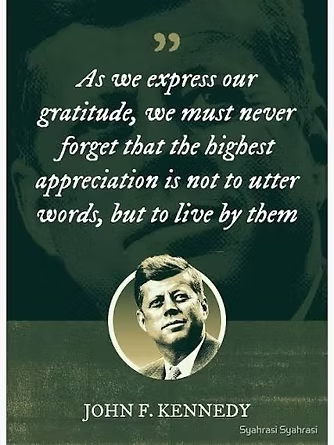
Near the end of the Proclamation, Kennedy left us with these memorable words: “As we express our gratitude, we must never forget that the highest appreciation is not to utter words, but to live by them. Let us therefore proclaim our gratitude to Providence for manifold blessings – let us be humbly thankful for inherited ideals – and let us resolve to share those blessings and those ideals with our fellow human beings throughout the world.”
Happy Thanksgiving everybody.
Kevin Diehl